


Fanny and Alexander
This is essentially a four act play. In the first act we meet the Ekdahl family -- large, joyous, prosperous. Then Oscar (Allan Edwall), father of Alexander (Bertil Guve) who might be 11 and Fanny (Pe…

Fanny and Alexander
This is essentially a four act play. In the first act we meet the Ekdahl family -- large, joyous, prosperous. Then Oscar (Allan Edwall), father of Alexander (Bertil Guve) who might be 11 and Fanny (Pernilla Allwin) who might be 7, dies. In act two, Oscar appears to his children. Alexander asks why he doesn't go off to Heaven. Oscar replies that he doesn't want to leave those he lived with. The children's mother remarries in less than a year, going to a strict Bishop Edvard Vergerus' (Jan Malmsjö) house with none of her furniture, none of the children's toys, and an optimism that she can make a good thing of it despite his powerfully controlling personality. Alexander learns from the ghost of the Bishop's first wife that she and her children died trying to escape after having been locked up for days. They climbed out a window but failed to make it across the cold fast-flowing stream that separates the back of the house from the town. Alexander tells this to a servant who repeats it to the Bishop. The Bishop must discredit this story, and demands retraction. Then he locks up the boy. In act three, Isak (Erland Josephson), a family friend, arrives at the house, ostensibly to buy a chest, but actually to smuggle the children out of the house (in the chest!). During this escape, the ghosts of his former family appear to the Bishop. The children are kept for the moment in Isak's house, where Alexander meets Ismael Retzinsky (Stina Ekblad) whose paranormal abilities help Alexander start a fire in the Bishop's house, a fire that is fatal to the hated step-father. In the final act, mother (Ewa Fröling) and children are back in the warm comfort of their extended family's house. Gustav (Jarl Kulle), the late Oscar's brother, gives a toast in which he summarizes the play. Without mentioning ghosts explicitly, he says there are things we know and should enjoy, such as food and dance, and many more aspects of life of which we are ignorant.
Fanny and Alexander
Drama
Film Details
This is essentially a four act play. In the first act we meet the Ekdahl family -- large, joyous, prosperous. Then Oscar (Allan Edwall), father of Alexander (Bertil Guve) who might be 11 and Fanny (Pernilla Allwin) who might be 7, dies.
In act two, Oscar appears to his children. Alexander asks why he doesn't go off to Heaven. Oscar replies that he doesn't want to leave those he lived with.
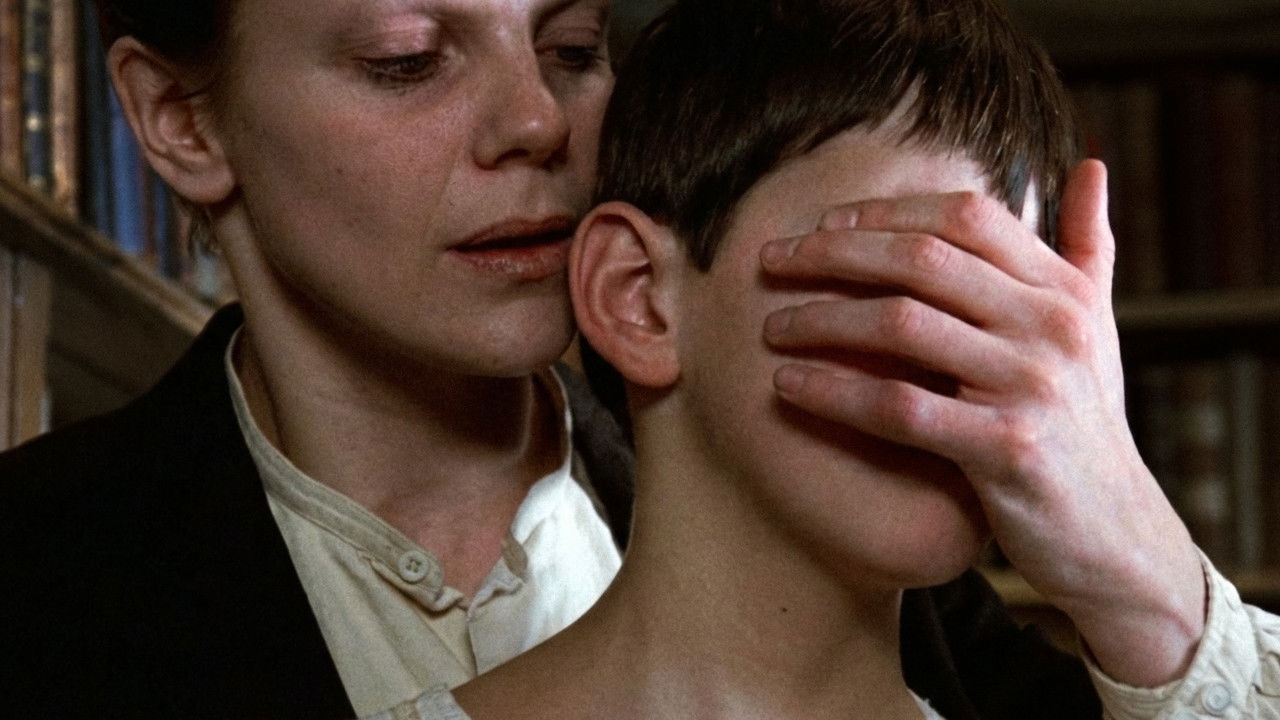
The children's mother remarries in less than a year, going to a strict Bishop Edvard Vergerus' (Jan Malmsjö) house with none of her furniture, none of the children's toys, and an optimism that she can make a good thing of it despite his powerfully controlling personality. Alexander learns from the ghost of the Bishop's first wife that she and her children died trying to escape after having been locked up for days. They climbed out a window but failed to make it across the cold fast-flowing stream that separates the back of the house from the town.
Alexander tells this to a servant who repeats it to the Bishop. The Bishop must discredit this story, and demands retraction. Then he locks up the boy.
In act three, Isak (Erland Josephson), a family friend, arrives at the house, ostensibly to buy a chest, but actually to smuggle the children out of the house (in the chest!). During this escape, the ghosts of his former family appear to the Bishop. The children are kept for the moment in Isak's house, where Alexander meets Ismael Retzinsky (Stina Ekblad) whose paranormal abilities help Alexander start a fire in the Bishop's house, a fire that is fatal to the hated step-father.
In the final act, mother (Ewa Fröling) and children are back in the warm comfort of their extended family's house. Gustav (Jarl Kulle), the late Oscar's brother, gives a toast in which he summarizes the play. Without mentioning ghosts explicitly, he says there are things we know and should enjoy, such as food and dance, and many more aspects of life of which we are ignorant..