


Fantasia
Fantasia opens with live action scenes of members of an orchestra gathering against a blue background and tuning their instruments in half-light, half-shadow. Master of ceremonies Deems Taylor enters…
Fantasia
Fantasia opens with live action scenes of members of an orchestra gathering against a blue background and tuning their instruments in half-light, half-shadow. Master of ceremonies Deems Taylor enters the stage (also in half-light, half-shadow) and introduces the program. The music has 3 kinds of stories, one with definite stories and narratives, two with no story, but definite pictures and third more abstract (music that exists for its own sake). The eight animation sequences are colorful, impressive, free-flowing, abstract, and often surrealistic pieces. Toccata and Fugue in D Minor by Johann Sebastian Bach. Master of ceremonies Deems Taylor arrives and delivers an introduction to the film. Conductor Leopold Stokowski appears and begins conducting the first strains of his own orchestration of the Toccata and Fugue in D Minor, by Johann Sebastian Bach (originally written for solo organ). Toccata and Fugue was inspired primarily by the work of German abstract animator Oskar Fischinger, who had actually worked for a brief time on this segment. The animation segues back into the live-action footage of Stokowski as the piece concludes, setting the precedent for the rest of the musical numbers. Live-action shots of the orchestra illuminated in blue and gold, backed by superimposed shadows, fade into abstract patterns. Animated lines, shapes and cloud formations reflect the sound and rhythms of the music. The Nutcracker Suite by Pyotr Ilyich Tchaikovsky. Selections from the ballet suite underscore scenes depicting the changing of the seasons from summer to autumn to winter. Unlike the ballet, this version has no plot. It features a variety of dances, just as in the original, but danced by animated fairies, fish, flowers, mushrooms, and leaves; no actual nutcracker is ever seen in this version. Many elements are rendered carefully and painstakingly using techniques such as dry brush and airbrush. The musical segments are as follows: As dawn breaks over a meadow, during the "Dance of the Sugar Plum Fairy"; tiny fairies sprinkle drops of dew on every flower and stern. A cluster of tiny mushrooms, dressed in long robes and coolie hats resembling Chinese (plus one little mushroom always out-of-step), perform the "Chinese Dance." Multicolored blossoms shaped like ballerinas perform the "Dance of the Flutes." A school of underwater goldfish performs a graceful "Arab Dance." High-kicking thistles, dressed like Cossacks, and orchids dressed like lovely Russian peasant girls, join together for the wild "Russian Dance." In the final musical segment, "Waltz of the Flowers," autumn fairies color everything they touch brown and gold with their wands. Then the frost fairies arrive, and everything becomes part of an icy, jewel-like pattern among falling snowflakes. The Sorcerer's Apprentice by Paul Dukas. Based on Goethe's 1797 poem "Der Zauberlehrling". It is the story of the sorcerer Yen Sid's ambitious, but lazy, assistant who attempts to work some of the magical feats of his master before he knows how to properly control them. "The Sorcerer's Apprentice" with Mickey Mouse as the title character brings a broom to life to carry water for him. But forgets the magic formula to make them stop & ends up flooding the whole castle. After the music ends, Mickey and conductor Leopold Stokowski, seen in silhouette, congratulate each other with a live-action/animation handshake. Rite of Spring by Igor Stravinsky. A visual history of the Earth's beginnings is depicted to selected sections of the ballet score. The sequence progresses from the planet's formation to the first living creatures, followed by the reign and extinction of the dinosaurs ("terrible lizard" in Greek). The sequence showcased realistically animated prehistoric creatures including Tyrannosaurus Rex, Dimetrodon, Parasaurolophus, Apatosaurus, Triceratops, Ornithomimus, and Stegosaurus, and used extensive and complicated special effects to depict volcanoes, boiling lava, and earthquakes. The large carnivorous dinosaur attacking the Stegosaurus is a villainous Tyrannosaurus Rex. Journey of prehistoric Earth from molten lava to single celled organisms, to a surface filled with marine life & then dinosaurs (who rules for 200 MM years) which are depicted to have been rendered extinct due to a drought. Intermission/Meet the Soundtrack: Deems Taylor announces a fifteen-minute intermission following the conclusion of The Rite of Spring. The musicians are seen departing the orchestra stand, and the doors close to reveal a title card. After the intermission there is a brief jam session of jazz music led by a clarinetist as the orchestra members return. Then a humorously stylized demonstration of how sound is rendered on film is shown. An animated sound track "character", initially a straight white line, changes into different shapes and colors based on the sounds played. The Pastoral Symphony by Ludwig van Beethoven. A mythical Greco-Roman world of colorful centaurs and "centaurettes", cupids, fauns and other figures from classical mythology of Mount Olympus is portrayed to Beethoven's music. Then a Greek odyssey with Pegasus (baby Pegasus learning to fly), half man half horse (Centaurs) male & females (Centaurettes) going bonkers over each other. It tells the story of the mythological creatures gathering for a festival to honor Bacchus, the god of wine riding his horned donkey, Jacchus, which is disturbed by Zeus, who decides to amuse himself by throwing lightning bolts at the attendees. Then the sun god Apollo riding his chariot to bring day & then the goddess of night Morpheus spreading her cloth to engulf the sky into the embrace of darkness. Dance of the Hours by Amilcare Ponchielli. A comic ballet in four sections: Madame Upanova and her ostriches (Morning); Hyacinth Hippo and her servants (Afternoon); Elephanchine and her bubble-blowing elephant troupe (Evening); and Ben Ali Gator and his troop of alligators (Night). Ballet dancing conducted by elephants, Hippos & ostriches. The ballet is attacked by crocodiles also in ballet & is overridden by them, but eventually the elephants, hippos & ostriches fight back & take their stage back. The finale finds all of the characters dancing together until their palace collapses. Night on Bald Mountain by Modest Mussorgsky and Ave Maria by Franz Schubert. At midnight the devil Chernabog awakes and summons evil spirits and restless souls from their graves to Bald Mountain. The spirits dance and fly through the air until driven back by the sound of an Angelus bell as night fades into dawn. The multi-plane camera tracks away from Bald Mountain to reveal a line of faithful robed religious figures with lighted torches. The camera follows them as they go through the forest and ruins of a cathedral to the sounds of Ave Maria. The camera slowly zooms through a thicket to a serene horizon with a hill, and a sunrise is shown shining beyond the horizon.
Fantasia
Animation,Family,Fantasy
Film Details

Fantasia opens with live action scenes of members of an orchestra gathering against a blue background and tuning their instruments in half-light, half-shadow. Master of ceremonies Deems Taylor enters the stage (also in half-light, half-shadow) and introduces the program. The music has 3 kinds of stories, one with definite stories and narratives, two with no story, but definite pictures and third more abstract (music that exists for its own sake).
The eight animation sequences are colorful, impressive, free-flowing, abstract, and often surrealistic pieces. Toccata and Fugue in D Minor by Johann Sebastian Bach. Master of ceremonies Deems Taylor arrives and delivers an introduction to the film.
Conductor Leopold Stokowski appears and begins conducting the first strains of his own orchestration of the Toccata and Fugue in D Minor, by Johann Sebastian Bach (originally written for solo organ). Toccata and Fugue was inspired primarily by the work of German abstract animator Oskar Fischinger, who had actually worked for a brief time on this segment. The animation segues back into the live-action footage of Stokowski as the piece concludes, setting the precedent for the rest of the musical numbers.
Live-action shots of the orchestra illuminated in blue and gold, backed by superimposed shadows, fade into abstract patterns. Animated lines, shapes and cloud formations reflect the sound and rhythms of the music. The Nutcracker Suite by Pyotr Ilyich Tchaikovsky.
Selections from the ballet suite underscore scenes depicting the changing of the seasons from summer to autumn to winter. Unlike the ballet, this version has no plot. It features a variety of dances, just as in the original, but danced by animated fairies, fish, flowers, mushrooms, and leaves; no actual nutcracker is ever seen in this version.
Many elements are rendered carefully and painstakingly using techniques such as dry brush and airbrush. The musical segments are as follows: As dawn breaks over a meadow, during the "Dance of the Sugar Plum Fairy"; tiny fairies sprinkle drops of dew on every flower and stern. A cluster of tiny mushrooms, dressed in long robes and coolie hats resembling Chinese (plus one little mushroom always out-of-step), perform the "Chinese Dance." Multicolored blossoms shaped like ballerinas perform the "Dance of the Flutes." A school of underwater goldfish performs a graceful "Arab Dance." High-kicking thistles, dressed like Cossacks, and orchids dressed like lovely Russian peasant girls, join together for the wild "Russian Dance." In the final musical segment, "Waltz of the Flowers," autumn fairies color everything they touch brown and gold with their wands.
Then the frost fairies arrive, and everything becomes part of an icy, jewel-like pattern among falling snowflakes. The Sorcerer's Apprentice by Paul Dukas. Based on Goethe's 1797 poem "Der Zauberlehrling".
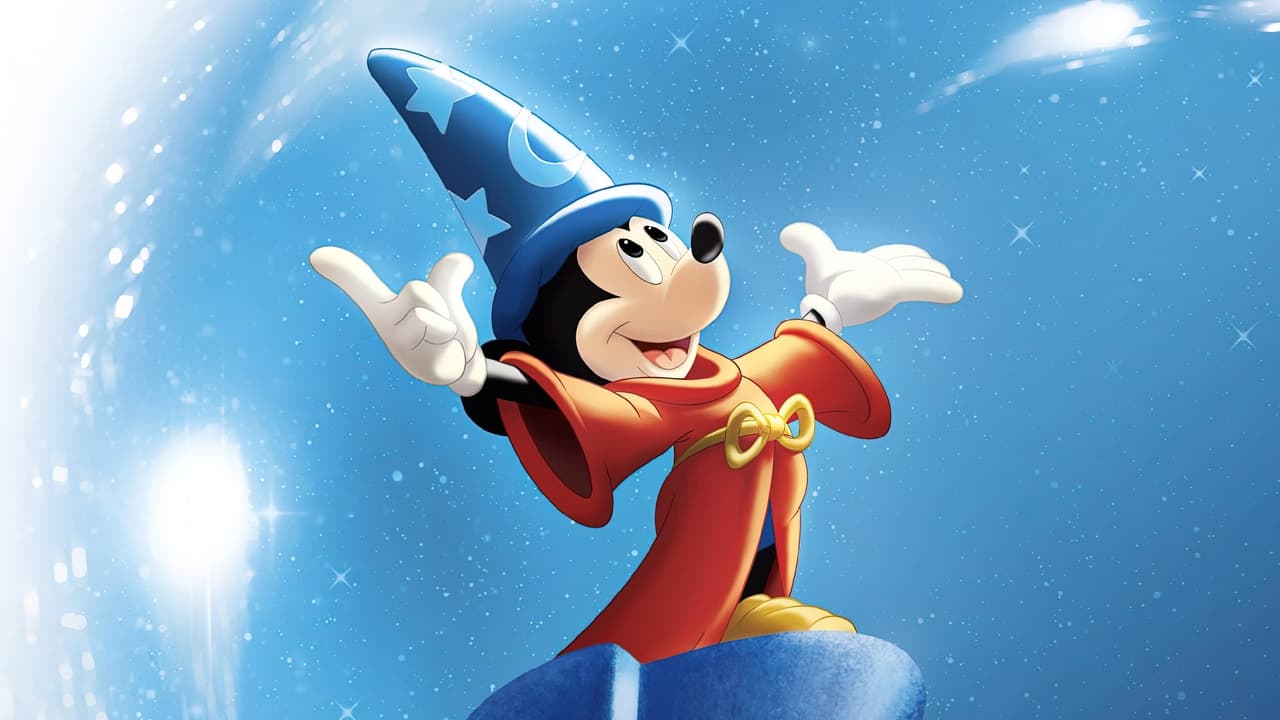
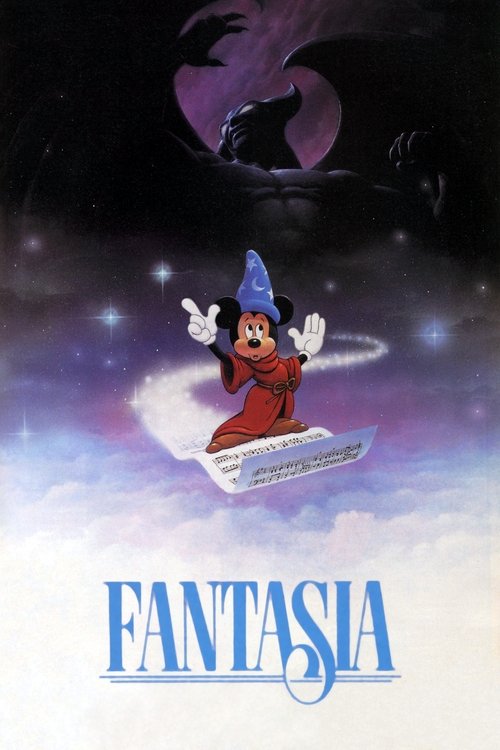
It is the story of the sorcerer Yen Sid's ambitious, but lazy, assistant who attempts to work some of the magical feats of his master before he knows how to properly control them. "The Sorcerer's Apprentice" with Mickey Mouse as the title character brings a broom to life to carry water for him. But forgets the magic formula to make them stop & ends up flooding the whole castle.
After the music ends, Mickey and conductor Leopold Stokowski, seen in silhouette, congratulate each other with a live-action/animation handshake. Rite of Spring by Igor Stravinsky. A visual history of the Earth's beginnings is depicted to selected sections of the ballet score.
The sequence progresses from the planet's formation to the first living creatures, followed by the reign and extinction of the dinosaurs ("terrible lizard" in Greek). The sequence showcased realistically animated prehistoric creatures including Tyrannosaurus Rex, Dimetrodon, Parasaurolophus, Apatosaurus, Triceratops, Ornithomimus, and Stegosaurus, and used extensive and complicated special effects to depict volcanoes, boiling lava, and earthquakes. The large carnivorous dinosaur attacking the Stegosaurus is a villainous Tyrannosaurus Rex.
Journey of prehistoric Earth from molten lava to single celled organisms, to a surface filled with marine life & then dinosaurs (who rules for 200 MM years) which are depicted to have been rendered extinct due to a drought. Intermission/Meet the Soundtrack: Deems Taylor announces a fifteen-minute intermission following the conclusion of The Rite of Spring. The musicians are seen departing the orchestra stand, and the doors close to reveal a title card.
After the intermission there is a brief jam session of jazz music led by a clarinetist as the orchestra members return. Then a humorously stylized demonstration of how sound is rendered on film is shown. An animated sound track "character", initially a straight white line, changes into different shapes and colors based on the sounds played.
The Pastoral Symphony by Ludwig van Beethoven. A mythical Greco-Roman world of colorful centaurs and "centaurettes", cupids, fauns and other figures from classical mythology of Mount Olympus is portrayed to Beethoven's music. Then a Greek odyssey with Pegasus (baby Pegasus learning to fly), half man half horse (Centaurs) male & females (Centaurettes) going bonkers over each other.
It tells the story of the mythological creatures gathering for a festival to honor Bacchus, the god of wine riding his horned donkey, Jacchus, which is disturbed by Zeus, who decides to amuse himself by throwing lightning bolts at the attendees. Then the sun god Apollo riding his chariot to bring day & then the goddess of night Morpheus spreading her cloth to engulf the sky into the embrace of darkness. Dance of the Hours by Amilcare Ponchielli.
A comic ballet in four sections: Madame Upanova and her ostriches (Morning); Hyacinth Hippo and her servants (Afternoon); Elephanchine and her bubble-blowing elephant troupe (Evening); and Ben Ali Gator and his troop of alligators (Night). Ballet dancing conducted by elephants, Hippos & ostriches. The ballet is attacked by crocodiles also in ballet & is overridden by them, but eventually the elephants, hippos & ostriches fight back & take their stage back.
The finale finds all of the characters dancing together until their palace collapses. Night on Bald Mountain by Modest Mussorgsky and Ave Maria by Franz Schubert. At midnight the devil Chernabog awakes and summons evil spirits and restless souls from their graves to Bald Mountain.
The spirits dance and fly through the air until driven back by the sound of an Angelus bell as night fades into dawn. The multi-plane camera tracks away from Bald Mountain to reveal a line of faithful robed religious figures with lighted torches. The camera follows them as they go through the forest and ruins of a cathedral to the sounds of Ave Maria.
The camera slowly zooms through a thicket to a serene horizon with a hill, and a sunrise is shown shining beyond the horizon..