


Gambling
The adopted daughter of gambler, Al Draper, is found murdered in a hotel room. Draper is dissatisfied with the handling of the case by the district attorney and sets out to work the case himself. The…
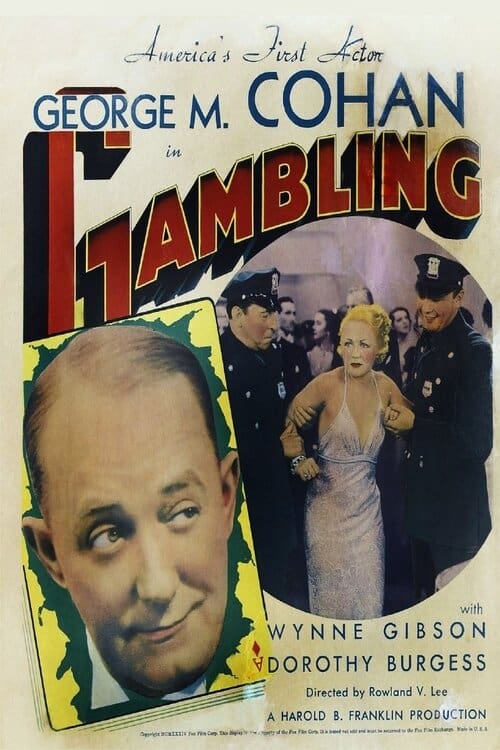
Gambling
The adopted daughter of gambler, Al Draper, is found murdered in a hotel room. Draper is dissatisfied with the handling of the case by the district attorney and sets out to work the case himself. The adopted daughter of New-York-City gambler, Al Draper, elopes from quarantine with another voyager from Europe. Later she is found murdered in a hotel room. Draper is dissatisfied with the handling of the case by the district attorney and sets out to work the case himself. —Les Adams <longhorn1939@suddenlink.net> George M. Cohan, that "Yankee Doodle" boy, deserves a far better break than the dispensers of celluloid have dished out to him to date. Having had one rather indifferent experience with Paramount, the veteran of many seasons on the legitimate stage is handicapped in his second effort in what is only average entertainment, retarded by a routine story that fails to be lifted by routine direction. He is a gambler, his life wrapped up in an adopted daughter who is never seen in the picture. Found murdered presumably, suspicion shifts and divides itself among three people: the boy the girl was supposed to marry; Dorothy Burgess, already his wife, and Wynne Gibson. The trial results in an acquittal for the boy, whereupon Cohan turns detective until he discovers who committed the deed, which, eventually, turns out to be an accident. Suspense, presaged by the drift of the story in its earlier sequences, never develops in sizable enough quantity. Then, too, there is little of the imaginative in the direction. While performances, led off by Cohan's, are adequate, the entire mood of "Gambling" somehow or other reminds of another and earlier day in production. —Motion Picture Daily
Gambling
Crime,Drama,Mystery
Film Details
The adopted daughter of gambler, Al Draper, is found murdered in a hotel room. Draper is dissatisfied with the handling of the case by the district attorney and sets out to work the case himself. The adopted daughter of New-York-City gambler, Al Draper, elopes from quarantine with another voyager from Europe.
Later she is found murdered in a hotel room. Draper is dissatisfied with the handling of the case by the district attorney and sets out to work the case himself. —Les Adams <longhorn1939@suddenlink.net> George M.
Cohan, that "Yankee Doodle" boy, deserves a far better break than the dispensers of celluloid have dished out to him to date. Having had one rather indifferent experience with Paramount, the veteran of many seasons on the legitimate stage is handicapped in his second effort in what is only average entertainment, retarded by a routine story that fails to be lifted by routine direction. He is a gambler, his life wrapped up in an adopted daughter who is never seen in the picture.
Found murdered presumably, suspicion shifts and divides itself among three people: the boy the girl was supposed to marry; Dorothy Burgess, already his wife, and Wynne Gibson. The trial results in an acquittal for the boy, whereupon Cohan turns detective until he discovers who committed the deed, which, eventually, turns out to be an accident. Suspense, presaged by the drift of the story in its earlier sequences, never develops in sizable enough quantity.
Then, too, there is little of the imaginative in the direction. While performances, led off by Cohan's, are adequate, the entire mood of "Gambling" somehow or other reminds of another and earlier day in production. —Motion Picture Daily.